
This article includes the talking points created by ChatGPT that we covered in our podcast. The complete automated transcript of the podcast can be accessed by clicking the ‘transcript’ button under the podcast window at the top of the article.
Intro Haiku:
Protesting business
Economic battleground
Dividing people
Today’s podcast focuses on the Indivisible Sequim May Day protest; read about the event here.
Intro:
May 1st — May Day — isn’t just a date. It comes with a long, complicated history that still shapes how it’s used today.
It starts with the Haymarket Affair in Chicago. Workers were striking for an eight-hour workday when a protest turned violent after a bomb went off and police opened fire. In the aftermath, several labor activists were executed, and the event became a lasting symbol of worker struggle.
In 1889, the Second International — a coalition of socialist groups — declared May 1st an international day for workers. The goal was simple: unify labor movements and push for better conditions.
Over time, the meaning shifted. In the 20th century, especially after the rise of communist governments, May Day became something more centralized and political. In the Soviet Union and across the Eastern Bloc, it turned into a state-run event—large parades, military displays, and public demonstrations of government power, often staged in places like Red Square.
Today, May Day still carries both identities. It’s recognized in many places as a workers’ holiday, but it also remains closely tied to activism rooted in those same socialist traditions.
So when looking at a May Day event happening in Sequim, it’s worth remembering: this isn’t just a local gathering. It’s part of a much bigger historical and political tradition — and that context matters when asking what these events mean for a small community like Sequim.
🎙️ Counter Discussion: May Day Event in Sequim
Quick context (from their own page)
The Indivisible Sequim May Day event is part of a broader national effort encouraging:
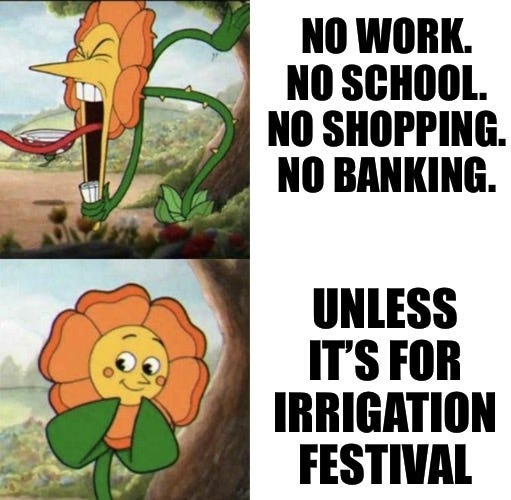
“No Work. No School. No Shopping. No Banking.” (Indivisible)
Economic disruption to “flex…economic power” and stop “business as usual” (Indivisible)
A coordinated, nationwide day of non-participation in normal economic and civic life (Indivisible)
Their local page also includes a caveat encouraging people to still support local businesses during Sequim’s Irrigation Festival (Indivisible Sequim)
1) Impact on a Small Rural Economy (Sales Tax + Tourism)
Why this matters: Sequim is a small, tourism-dependent town where sales tax and local spending are a major part of funding public services.
Key point: A coordinated call for “no shopping” and “no work” directly cuts into:
Daily retail revenue
Restaurant traffic
Tourism spending during a key seasonal window
In a large city, one day may be absorbed. In a small town, it’s felt immediately.
“If you tell people not to shop or work—even for one day—that’s not abstract. That’s money not going into local businesses, not paying wages, and not generating tax revenue for the community.”
Community impact
Reduced sales tax → less funding for infrastructure, emergency services, schools
Small businesses (already thin margins) lose a full day of income
Seasonal events like the Irrigation Festival depend on strong turnout
Discussion questions
How much lost revenue can small businesses realistically absorb?
Should national protest strategies be adapted for small-town economies?
Who actually bears the cost of a “no shopping” day locally?
2) Message to Students: Protest vs. Education
Why this matters: The event explicitly encourages students to skip school or walk out (Indivisible)
Key point:
This creates a value signal: Civic action is framed as more important than showing up for education.
“Encouraging kids to skip school sends a message that education is optional when something political comes up.”
Community impact
Undermines school attendance norms
Puts teachers and administrators in difficult positions
Creates inconsistency: some students participate, others don’t
Balanced nuance (important for credibility)
Civic engagement can be valuable
But structured civic education vs. unsupervised walkouts are not the same
Discussion questions
Where’s the line between civic engagement and undermining education?
Should schools be neutral spaces or political organizing grounds?
Who is responsible for the consequences of missed instruction time?
3) Workforce Disruption & Business Operations
Why this matters: The event explicitly calls for people to not go to work (Indivisible)
Key point
This doesn’t just affect “big corporations”—it hits:
Local employers
Co-workers covering shifts
Essential services
“If people don’t show up to work, someone else has to pick up the slack—or the business just loses productivity entirely.”
Community impact
Staffing shortages for small businesses
Lost wages for hourly workers
Potential service disruptions (healthcare, retail, food service)
Real-world tension
Even supporters acknowledge timing issues—some workers can’t afford to miss work or get time off easily.
Discussion questions
Who can afford to participate—and who can’t?
Does this kind of protest disproportionately affect working-class people?
Is it reasonable to expect employers and coworkers to absorb the disruption?
4) Does the Event Support the Local Community?
Why this matters: The messaging is national and ideological, but the effects are local and economic.
Key point
The event is designed to disrupt normal community function:
No shopping
No work
No school
That inherently conflicts with:
Supporting local businesses
Maintaining community stability
“You can’t both disrupt your local economy and claim to support it at the same time.”
Community impact
Divides residents (participants vs. non-participants)
Creates tension between activism and everyday life
Risks alienating small business owners
Discussion questions
What does “supporting the community” actually mean in practice?
Are there ways to protest that don’t harm local neighbors?
Who decides what trade-offs are acceptable?
5) The “Big Caveat” Contradiction: Their statement
They say: Support local businesses during the Irrigation Festival (Indivisible Sequim)

Why this matters:
This directly conflicts with:
“No shopping”
Economic disruption strategy
Key point
The protest relies on withholding economic activity, but the caveat asks people to continue economic activity locally.
Plain-English framing
“They’re saying ‘don’t spend money’—but also ‘please spend money here.’ Those two ideas cancel each other out.”
Deeper critique
If people do spend locally → protest loses impact
If people don’t spend → local businesses are harmed
Either way, the strategy becomes inconsistent.
Discussion questions
Can you selectively apply economic disruption without undermining the strategy?
Does this caveat acknowledge unintended harm—or just try to soften it?
Is this a messaging contradiction or a practical compromise?
Idée fixe (French for "fixed idea") is a 19th-century term for an irrational obsession, passion, or mental preoccupation that dominates a person's thoughts, resisting all attempts to change it. It originated as a clinical term for severe obsession but is also used for milder, obsessive tendencies or as a recurring thematic motif in music (e.g., Berlioz) and literature.
🎯 Closing:
“This event is built around the idea that stopping normal life creates leverage. But in a small town like Sequim, ‘normal life’ isn’t abstract—it’s your neighbor’s business, your kid’s school, and your local economy. The real question isn’t whether protest is valid—it’s whether this specific kind of protest helps or harms the community it’s happening in.”
Friday Reminders:
Go to school, work, shop, and if the bank isn’t closed take advantage of it.
Also, new Strait Shooter is out on Friday, the only satire news source in Clallam County.
YouTube Media:
What was on our TV during the podcast:
Fascinating vending machines in Japan:
Thank you for reading, laughing, sharing & subscribing!
Strait Shooter:
Don’t miss the best — and only — satirical news in Clallam County. The latest Friday edition shoots into inboxes at 6:03 this morning!
Community Opportunities:
4PA:
Calico Cat Social Club:
Clallam County Letters:
New issues are published at 6am every Monday and Thursday.
✍️ Now Accepting Rejected Letters to Local Newspapers:
Have you had a letter to the editor rejected from the Sequim Gazette or the Peninsula Daily News? Clallam County Letters will publish it.
While this blog is focused on letters to elected officials and government, it is also a platform for the silenced, unheard, and ignored voices of Clallam County residents.
Email your letter, along with the response from the newspaper stating why they wouldn’t print the letter, to clallamityjen@gmail.com. Names, emails, and personal information will be redacted from published letters.
Clallam County Letters accepts emails to county, city, state, and federal government officials.
✍️ Redress State Legislators in District 24:
Senator Mike Chapman: (360) 786-7646, email form
Representative Adam Bernbaum: (360) 786-7916, email form
Representative Steve Tharinger: (360) 786-7904, email form
✍️ Redress Clallam County Commissioners:
Mark Ozias: Mark.Ozias@clallamcountywa.gov
Randy Johnson: Randy.Johnson@clallamcountywa.gov
Mike French: Mike.French@clallamcountywa.gov
Loni Gores, Clerk: Loni.Gores@clallamcountywa.gov
Find all other Clallam County officials, offices, and employees in the staff directory.
To have your letter published in Clallam County Letters, please include clallamityjen@gmail.com in the BCC field or forward after sending.